Wednesday, October 31, 2012

What I Am Reading - Blacksad: A Silent Hell

Blacksad by Juan Diaz Canalez and Juanjo Guarnido

I love Blacksad.  This is the second Blacksad book, which collects the fourth and latest story as well as a few back up strips and an in depth write up about the artistic decisions by artist, Juanjo Guarnido.  This volume isn't quite as robust as the first volume, but it's still a great read.

What I love about this comic is that not only is it a great throwback to classic noir storytelling, but it's also a throwback to classic comic tropes in that the characters are all animal people.  Using animals in place of people is such a great technique for conveying a massive amount of information in as short a space possible.  We, as people, ascribe natural attributes to animals that are largely universal across all cultures.  By casting different animals as different characters, the reader is instantly able to infer certain characteristics, which can also then be undermined.  It's an effect that cannot be achieved by simply drawing human beings.

Anybody who likes comics, who likes to see the true artistry of the medium, must read these books.

Sunday, October 28, 2012

What I Am Reading - Breathers

Breathers by Justin Madson


I met Justin a few months ago in Chicago.  He's a very nice guy.  I've seen this book talked about in a few places around the web and I'm surprised I haven't seen it talked about more because I liked it a lot. 

Breathers is is a beautiful blend of indie drama and neo noir science fiction.  The story is told in small vignettes that follow a few different characters and how they get through their lives in a world where the air is poisonous to breathe.  This comic is light on text, more focused on the character's emotional drama than it is on the storyline.  It all plays well with Madson's cartooning.  The light line work combined with the stylistically long limbs give the characters a surreal, airless feeling.  They float on the page like their float through their lives.

This is a fantastic self published book.  You can purchase the 426 page collection here.  I highly recommend it.

Sunday, October 21, 2012

Character Study - Wolverine

I don't think I need to bother detailing the immense popularity of Wolverine.  He's the only X-Man to sustain a solo book for 20 years, appear in multiple team books on a monthly basis, and even appear in his own feature film.  Indeed, since the success of the X-Men films in the last ten years, the entire X-Men franchise has been reconditioned to revolve around him.  It is not uncommon to see books and cartoons titled "Wolverine and the X-Men".  So, how does Wolverine relate to the sexual subtexts of the X-Men?  Interestingly enough, I think he is the epitome of sexual frustration that goes along with puberty, being an x-men, and indeed the very concept of "being a man".

The two defining aspects of Wolverine are his violence and his romantic relationships.  His character is often  presented as being an old man, a mentor, or a warrior seeking peace of mind or forgiveness.  His mutant powers give him a much longer lifespan than the average human being, or mutant for that matter.  Though he may be older than the average X-Man (in theory they are teenagers), due to his mutant powers he can still metaphorically be considered an adolescent.  Her certainly exhibits adolescent tendencies, particularly in his love life.


Wolverine is completely masculine.  He is pure machismo and has no feminine qualities, though he will periodically try to learn them.  Wolverine is born out of the no nonsense, stop pussy footing around, be a man and get things done attitude that became very popular in American heroes after the Viet Nam War.  He was used as a contrast against Cyclops, who often struggled with the weight of responsibility that came with "being a man".  Wolverine had no such struggle with the concept and this was meant to be his weakness.  He embraces his masculine qualities with joy.  He's violent, insensitive, impulsive, stubborn, and emotionally stunted.  Over the course of the years he's grown to improve or subdue some of these various qualities, but Wolverine's story of redemption is constantly struggling with these demons.


As I say, as a result of being 100% masculine, Wolverine is consistently shown to have nothing but failed long term relationships with women.  I was going to make a list of all of Wolverine's past romantic relationships, but the task proved much too difficult.  Fortunately, his vast network of fans have already compiled such a list.  Looking through the list, you will see many names you recognize.  Though the lists also contains a lot of one night stands and in some cases joke or dubious hook ups, you will notice a repeating theme with all of Wolverine's love interests, particularly with the characters from larger stories or long term relationships.  The women Wolverine loves are either killed as a result of his ties to violence, or have rejected him as a result of him being an emotionally incomplete person.


To me, this perfectly encapsulates the turmoil of a teenage boy who is growing into a man.  Wolverine's powers allow him to heal from nearly any wound.  Physically, he is a peak man, strong and confident, not conventionally handsome but containing a musky mystique about him (sorry Mr. Jackman, you're too pretty).  He endures physical pain with an amazing stoicism and repeatedly accepts the responsibility and sacrifice that is expected of him.  Unfortunately, the one wound his powers can't heal is a broken heart.  Wolverine is often in spiritual turmoil, unable or unaware of how to deal with his emotional distresses.  As a result, he is in a constant state of sexual frustration, never able to find true love.

Wolverine's failed relationships are epitomized by two characters, Mariko Yashida and Jean Grey.   Mariko became the head of a Yakuza clan after Wolverine killed her father in an attempt to prove himself worthy to wed her.  Later, Mariko was poisoned and Wolverine was forced to mercy kill her.  Wolverine can't seem to separate his violence and his romance.

Conversely, with Jean Grey, she frequently wanted nothing to do with him, despite his being overprotective of her.  Through time, they developed a deep friendship, but more often than not Jean made it clear that Wolverine was not her idea of a suitable mate and that there were better candidates around.  Yet, he still pined after her, even questioning his own sanity for doing so.

If I had to psycho analyze Wolverine, I'd say he is sexually attracted to violence, or at least incapable of separating the two in his mind.  There was a short story written and drawn by Rafael Grampa that appeared in the recent anthology Strange Tales 2.  The story, titled Dear Logan, casts Wolverine and his enemies as professional wrestlers who kill each other in the ring to the cheers of the audience.  Wolverine receives a "Dear John" letter from his lover, explaining why she is breaking up with him, namely that he is a violent person who is using her as another outlet for violence in their masochistic relationship.  It is one of the single greatest Wolverine stories I have ever read and manages to completely sum up the character in 8 pages.

Wolverine started as a fairly superficial trouble making character, but very quickly grew to the deep analysis of young men, violence, and romance that he is today.  It is no wonder that he is now the face of the franchise.


Monday, October 8, 2012

Character Sudy - Gambit

Last week I talked about the sexual subtext in popular X-Men character Rogue; and you can't talk about Rogue without then talking about Gambit.  So, let's take a look at him.  He's one of the few X-men that has held a solo series for more than 12 issues and has appeared in many cartoons and video games.  Gambit as a character never really got a chance in the movie series, largely because his role as a mysterious troublemaker is already taken by the immensely more popular character, Wolverine, which I agreed with.  I initially didn't take to Gambit when he was first introduced in 1990 because he was largely derivative of Wolverine, in that he was a mysterious character with an unknown past.  But over time, Gambit was given a more distinct personality, his powers were developed a bit more, and he began an on again off again relationship with Rogue.

I never cared for the details of Gambit's shady past and was more interested in how he acted in a group dynamic.  The pairing of Gambit and Rogue was a pretty genius idea.  In analyzing Gambit's powers and the sexual subtext within them, we can see how well they compliment each other.  Rogue and Gambit are both strong characters by themselves, but when put together they support themselves as to make stronger characters out of each of them.  In a way, they are the perfect marriage of characters, ironic given that the cyclical nature of serial comics prevents them having a literal marriage.

Gambit has the mutant ability to charge the potential energy within any object, causing it to be unstable and explode.  This is his most visually distinctive trait, though if we look further we will see the subtleties of his powers and character.

If Rogue is the character that girls want to be and all boys want to be with, then Gambit is the character that all boys want to be and all girls want to be with.  Like Rogue, Gambit has a lot of masculine and feminine qualities.  The most distinctive aspect of Gambit's personality is that he's a real ladykiller.  He's a smooth talking Romeo that all the girls swoon over, and his powers and character reflect that.  Firstly, he's a professional thief.  He steals things for a living, especially girls' hearts.  In this way he's a romanticized boyfriend for young daydreaming girls, both attentive to their needs and ready to whisk them away on a whirlwind adventure.

The other extrapolation of Gambit's sexual powers is his hypnotic charm, which causes people to be susceptible to his suggestions.  This has been explained as saying he has the ability to "charge" the energy in people's brain, causing them to like him.  We can poetically describe this as a love touch.  Tragic then, that the man that can have any girl, falls in love with the one girl he can't touch.

Gambit and Rogue's powers provide the perfect amount of tension for two star crossed lovers:  Rogue, a girl who bathes in attention but longs for a lasting physical connection, and Gambit, the man who has seen the world and sown his oats but is drawn to the girl he cannot control.  They are the pinnacle of the societal ideal of the young, naive, virgin lady, and the worldly, roguish gentleman. 

Without Rogue, Gambit's character is kind of aimless, wandering through the X-Men franchise with little purpose or ambition.  Writers will try to trade in on his mysterious back story or his villainous past, but those aspects of the character don't hold much water.  People are drawn to the romanticism and drama of sexual frustration, and Rogue fills that position perfectly.

Sunday, September 30, 2012

Character Study - Rogue

Marvel Vs. Capcom 2
I've always found Rogue to be an interesting character.  There was a time, as young fan of the X-Men, when I would have considered her one of my favorite X-Men characters and definitely my favorite female character.  As a young teenage boy, I used to love to draw Rogue, though I don't know if I was ever sure why, other than the obvious fact that she was just cool (I think we all know why now).  Over time I've cooled on the character.  Like all X-Men characters, she's gone though a myriad of changes all in the name of Marvel's ongoing continuity, most of which I have no interest in.

It's impossible to deny Rogue's popularity.  She frequently places high in various lists and rankings, such as IGN's top 25 X-Men, where she places 5th, right behind Wolverine, and is the second highest female on the list.  Kitty Pryde beats out both Rogue and Wolverine for the number 3 spot, but hey, I don't see Weezer singing about Rogue or Wolverine, so there.  She plays a prominent role in various video games, movies, and cartoons.  In short, she is prevalent.
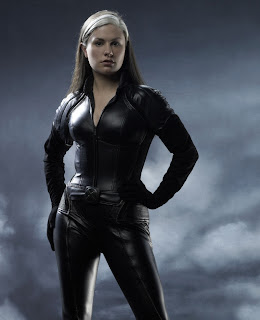

Anna Paquin as RogueSo, what is it about Rogue that makes her so popular?  I think the answer is as obvious as it is complex, but it starts with the simple fact that Rogue is hot sex dripping out of a latex body suit.  Rogue can often get lumped in with the other female characters as an example of sexism in comics, which I think is a little unfair.  I won't try to defend every artistic interpretation of her, but there is a difference between sexy and sexism (I differentiate the two not by the character's costume, physical attributes, or personality but instead by the way the character is framed and posed, which is more a case of an artist being sexist not a character being sexist) .  More importantly though, sex is very foundation of the character, which I think helps to explain her popularity among girls more so than boys.

Rogue, as a character, manages to maintain a very strong appeal to both girls and boys, due in part, I think, to the fact that both genders identify with her on a deep, sexual level.  Rogue is not a sexploitation character, like Psylock, who was a shy, insecure girl with dreams of becoming a warrior that got magically turned into a Japanese sex doll ninja.  That's a character arc, sure, but it's thin and has been used for nothing but visual titillation for the last 20 years.  Rogue's character, though still deeply sexual, is much deeper.

If you'll allow a brief diversion, I should clarify that at the root of the mythos, I believe the X-Men are about sex.  I'm not the first person to say this, Grant Morrison (in)famously wrote New X-Men #118, which was chock full of subliminal sex messages.  The beauty of the X-Men mythos is that the simple metaphor of teenagers turning into mutants is broad enough to cover a diverse amount of deep social or scientific subjects.  The X-men can be about racism, puberty, religion, evolution, generational divide, xenophobia, and so on.  It is the single greatest American Mythology created in the 20th Century, perhaps in all time.

In recent times, The X-Men have come to represent, and in my opinion suffer from an overt responsibility to, homosexuality, as evidenced in Marvel's recent big to do about having a gay marriage.  It's easy to see why the franchise has drifted that direction.  As I just said, the X-Men metaphor effortlessly conforms to the trials and tribulations of young homosexuals in America.  The X-Men have always been progressive, and gays in America is certainly en vogue in the media right now.

But if the X-Men metaphor were solely about homophobia, or racism for that matter, then I don't think the mythos would connect with as many people as it does.  After all, only something like 10% of the population is gay.  Sure, lots of people have opinions on racism and homophobia, and there is no shortage of "White Knights" in America, but the fact is not everybody is a minority, and the X-Men connect deeply with a majority of people.  Everybody, every single person on the planet, whether they be gay or straight, growing up in the racist south in the 20th Century or some kind of inconceivable utopian of tolerance in future, every single human past, present, and future, goes through puberty.

Paquin's influence loom large in modern representations of Rogue

Of course, that is not to say that the metaphor doesn't apply to racism, homophobia, etc.  The fact that it applies to all of them is what makes it so strong.

Rogue's power is that she cannot touch another human being without draining their life force, which seriously injures and can kill the person she's touching.  This also has the added bonus of briefly stealing the powers of another mutant.  Unable to have physical contact, Rogue can be squarely placed in the role of a Succubus or the temptress, but that reading really only appeals to boys, how do girls identify with a Succubus?

An important part of a mutant's origin is the first moment their powers materialize.  Often times it can be a traumatic experience, and it doesn't get much more traumatic than Rogue's.  Her powers first manifested themselves, like all mutants, when she was a young teenager, specifically, when she first kissed her boyfriend, Cody.  As a result of this carnal moment, Cody was left in a permanent coma.  Right there, we see that the foundation of Rogue's character equates sex with guilt.
art by Julie Bell
Rogue's character is the embodiment of Puritan Sex.  She is forced to be modest, covering her entire body, lest she accidentally touch (tempt) some poor person and send them to hell.  Modesty is a big issue for young girls growing up, particularly if they come from a religious home (as I suspect the majority of Americans do).  The notion that the way women dress can affect male actions and that they (women) have a moral responsibility not to stimulate sexual desires (outside of marriage, of course) is still prominent today in America, particularly among Mormons.  This is also the mentality that leads to "blaming the victim" in rape cases.

In this way, Rogue shows her rebellious wild streak by defying oppressive societal standards.  Though her mutant powers force her to be modest, she refuses to be a slave to it, flaunting her sexuality by wearing a skin tight body suit.  In this case, Rogue's cheesecake costume is absolutely fundamental to her character.  Rogue looks sexy, she feels sexy, she acts sexy, all in a way that girls identify with.  She wants, maybe even needs, to be admired, because she cannot be touched.

Rogue's sexuality extends beyond the subtext of her mutant powers, it also plays a prominent role in her character traits.  Rogue is not passive, she is aggressive and independent.  Though she can not know the touch of a man, outwardly, she doesn't need the help of one.  She's fun, outgoing, quirky, and intimidating.  She comfortably fills the role of the character that "all girls want to be, and all boys want to be with".
Jim Lee's classic design
Rogue is the pinnacle of femininity.  Girls want to emulate her strength, independence, and ownership of her sexuality, but still empathize with her loneliness and emotional weakness.  She is simultaneously feminine and masculine, balancing her dainty southern belle persona with her wild "no man can tame me" attitude. Boys see Rogue as the idealistic girlfriend, the kind of girl who is so great and beautiful that it's downright intimidating.  She is the girl at the party that everybody wants to talk to, but most boys are afraid to approach her, and the ones that do can't keep up with her.  She's also kind of crazy and a headcase, which accurately describes every woman I've ever dated (just a little sexism humor for you there...)

Rogue used to literally be a wild mare, possessing the enormous strength and flight of Ms. Marvel, but since her appearance in the movies by Bryan Singer, the character has been depowered in most incarnations.  I've been largely disappointed with this representation of Rogue, as I feel it diminishes the character.  The super strength and flight powers are visual extrapolations of her inner independence.

Rogue pouts it up in X-Men: EvolutionIn the movies, Rogue was portrayed as more of an insecure, shy girl, which dramatically shifts her character away from sexually powerful dynamo.  The foundation of guilty sex is there, but she loses a lot of her "envious" traits.  In recent times, Rogue is no longer presented as the fun, powerful, free spirit she used to be, instead she's a naive, stoic, introvert, which seems to be the typical "girl hero" archetype of the last ten years.  Movies meant for girls are full of blank faced sourpusses (Twilight, Hunger Games), as if that's supposed to be what all girls aspire to.  I don't particularly like it, but somebody obviously does.

I'd like to see Rogue return to the outgoing and aggressively fun character she used to be.  I think it's more representative of the X-Men mythology and a prefect example of what is so alluring about the franchise despite having numerous terrible books and movies bearing the logo.

All in all, I like my Rogue smiling.

Art by the legendary Hildebrant Brothers

Wednesday, September 19, 2012

Yeti Press

Yeti Press is a small publisher out of Chicago who publish a slew of quirky comics.  I don't have a whole lot to say about them, since I've only read one of their books, but I like the look of their website.  When I was at Wizard World, I had the pleasure of chatting with RJ Casey and Eric Roesner who sold me on their book, Pecos.  This is a fun comedy/western story that stars the eponymous Pecos Bill, a mythical western hero with a great mustache.  Roesner's cartooning carries the comedy really well


I liked this comic a lot, though if I'm being honest I think it's priced a bit high for a 16 page black and white book.  It is printed in an over sized format, but feels a little light.  Still, it was good and I'd like to read their second Pecos book.  I don't know if I'll order it from their store, but I'll look out for them at the next con I go to.


Sunday, September 9, 2012

Russell Lissau and Pop! Goes the Icon

Russell did a good job of selling me a lot of comics.  He's done some work for an anthology called Omega Comics Presents which is put out by Pop! Goes the Icon.  I picked up the Best of Volume One collection, as well as the first issue of Volume Two.  I also bought two mini comics he had done, which were pretty good.

The Omega Comics Presents books were both good looking comics.  I thought the Volume One collection was a little uneven, but it had some entertaining short stories and a slew of talented artists scattered throughout it.  It was an entertaining read, but nothing really jumped out at me save for a few artists.

Volume Two, on the other hand, was really fantastic.  This is a really strong issue that stands high above any of the previous stuff, possibly due in part to the coloring.  The lead story, Bluetick and Redbone, is a beautiful comic about a two small town roughnecks who get wrapped up in some criminal doings.  The story, written by Alex De-Gruchy, is paced really well and has a good flow.  The real star of the book is artist, mpMann, who was also one of the stronger aspects of Volume One.  He's got a real loose and playful cartooning style that has a lot of character.

The back up feature in Vol. 02 Issue 01 is written by Russell Lissau and drawn by Justin Castaneda called Down Time.  It's a lighthearted look at a supervillain who looses all his mercenary work after a humiliating defeat at the hands of an old bank security guard.  I always like stories that look at the mundane aspects of being a superhero or supervillain, and this one is good for a laugh.

Russell's two mini comics, One Last Thing and Daily Grind are both illustrated by mpMann and are also both good reads.  They are both short stories that focus on a small moment in a character's life in the middle of a big situation.  They play very well.  One Last Thing is a western interpretation of the music of Chris Mills, where as Daily Grind is the existential introspection of a middle aged man who hates his life. 

I've never been too huge on mini comics, mostly for the same reason I have eased off of regular monthly comics, but the personal aspect of meeting a comic creator and buying something from him personally more than make up for it.